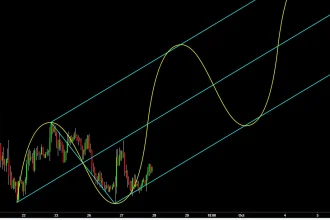




Regression Line in Financial Charts: Mathematical Foundations, Formulas, and Practical Applications
This educational–analytical article is prepared for assets such as gold, silver, Bitcoin, and others. It includes complete formulas, calculation steps, and practical insights.
Introduction
Financial market volatility drives traders and researchers to use statistical and mathematical tools to better understand price behavior.
The regression line is one of the simplest yet most powerful tools for modeling price trends over different time horizons.
The aim of this article is to provide a scientific–mathematical framework for calculating and applying regression in charts of assets such as gold, silver, and Bitcoin.
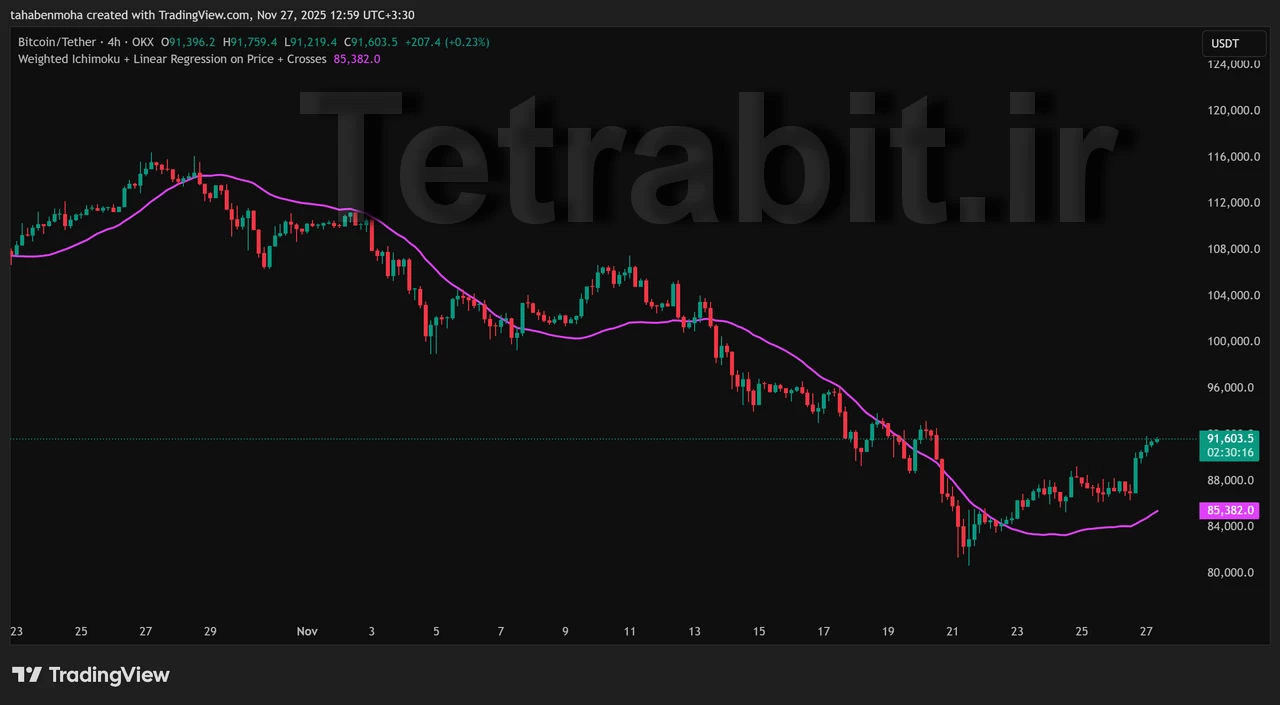
Definition and Basics of Linear Regression
In simple linear regression, the relationship between the independent variable \(x\) (e.g., time or candle index) and the dependent variable \(y\) (price) is modeled with a line:
\[
y = a + b x
\]
Here, \(a\) is the intercept and \(b\) is the slope. Coefficients are estimated using the least squares method, minimizing the sum of squared differences between observed and predicted values (residuals).
Least Squares Estimation Formulas
\[
b = \frac{\sum_{i=1}^{n} (x_i – \bar{x})(y_i – \bar{y})}{\sum_{i=1}^{n} (x_i – \bar{x})^2}
\]
\[
a = \bar{y} – b \bar{x}
\]
After computing \(a\) and \(b\), the predicted price is given by \( \hat{y}_i = a + b x_i \), and the residual for each observation is \( e_i = y_i – \hat{y}_i \).
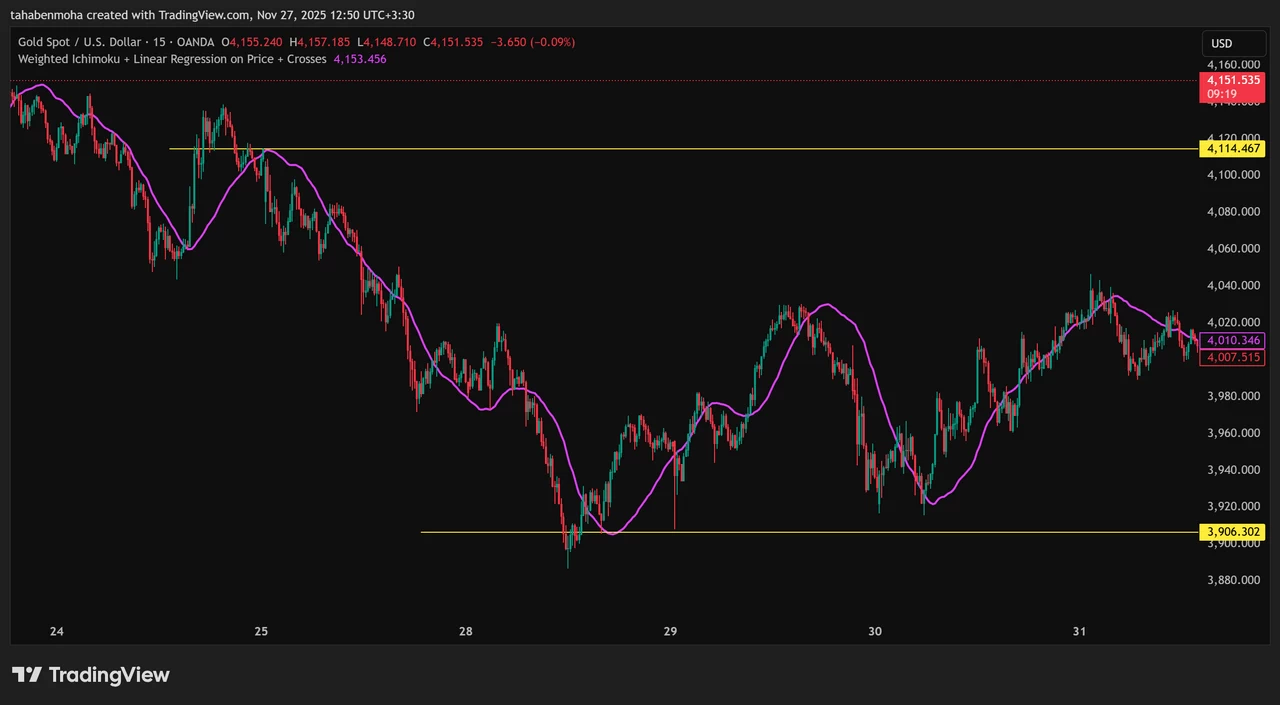
Model Validation: Coefficient of Determination and Errors
To assess the quality of fit, the coefficient of determination \(R^2\) is used:
\[
R^2 = 1 – \frac{\sum_{i=1}^{n} (y_i – \hat{y}_i)^2}{\sum_{i=1}^{n} (y_i – \bar{y})^2}
\]
\(R^2\) ranges between 0 and 1; higher values indicate that more variance in price is explained by the model. To estimate residual dispersion, the residual standard deviation is calculated:
\[
s_e = \sqrt{\frac{\sum_{i=1}^{n} (y_i – \hat{y}_i)^2}{n – 2}}
\]
Standard errors of coefficients are also computed classically:
\[
\text{SE}(b) = \frac{s_e}{\sqrt{\sum_{i=1}^{n} (x_i – \bar{x})^2}}
\]
\[
\text{SE}(a) = s_e \cdot \sqrt{ \frac{1}{n} + \frac{\bar{x}^2}{\sum_{i=1}^{n} (x_i – \bar{x})^2} }
\]
Types of Regression in Financial Markets
Linear Regression
Suitable for relatively stable trends such as certain phases of gold and silver. Its simplicity makes it widely used in analytical platforms.
Logarithmic Regression
\[
y = a + b \ln(x)
\]
For assets with quasi-exponential growth (like Bitcoin in long-term cycles), logarithmic transformation of time or price reveals slowing trends. Sometimes \(\ln(y)\) is used instead of \(x\) to linearize log-price.
Power Regression
\[
y = a \cdot x^{b}
\]
When power-law relationships exist, this model captures scaling structures. In practice, taking logarithms yields a linear form:
\[
\ln(y) = \ln(a) + b \cdot \ln(x)
\]
Regression Bands and Confidence Intervals
To evaluate probable price ranges, regression bands are drawn around the fitted line. A common approximation uses multiples of \(s_e\):
\[
\text{Upper Band}(x) = (a + b x) + k \cdot s_e
\]
\[
\text{Lower Band}(x) = (a + b x) – k \cdot s_e
\]
\(k\) is typically 1 or 2. For precise prediction intervals:
\[
\hat{y}(x) \pm t_{\alpha/2,\,n-2} \cdot s_e \cdot \sqrt{1 + \frac{1}{n} + \frac{(x – \bar{x})^2}{\sum (x_i – \bar{x})^2}}
\]
Practical Steps for Chart Implementation
- Select window: Choose a time frame (e.g., last 100 candles) to capture the current market phase.
- Define \(x\): Use candle index or normalized time as \(x\).
- Compute \(\bar{x}, \bar{y}\): Calculate averages over the chosen window.
- Estimate \(a, b\): Apply least squares formulas.
- Draw line: Plot \(\hat{y}(x)\) values on the chart.
- Compute residuals: \(e_i = y_i – \hat{y}_i\) and check for patterns or outliers.
- Bands and validation: Calculate \(s_e\), \(R^2\), and regression bands.
- Rolling update: Update parameters with a moving window to adapt to new data.
Example with Synthetic Gold Data
Day | Price (USD) |
|---|---|
1 | 1900 |
2 | 1910 |
3 | 1925 |
4 | 1930 |
5 | 1940 |
6 | 1955 |
7 | 1960 |
8 | 1975 |
9 | 1980 |
10 | 1995 |
With \(x = 1,2,\dots,10\) and formulas applied, an upward regression line is obtained. Then \(s_e\), \(R^2\), and upper/lower bands can be computed to assess trend strength.
Nonlinear Transformations: Log Price and Power Models
In cryptocurrencies, growth and correction cycles are often clearer with logarithmic transformations. Two common approaches:
- Regression on \(\ln(y)\): If \(\ln(y)\) vs. time is more linear, exponential price growth can be analyzed as a line.
- Power regression with \(\ln(x), \ln(y)\): When power-law structures exist, linear fitting in log-space provides better insight into long-term cycles.
Advantages and Limitations
- Advantages: Simplicity, fast computation, easy interpretation, compatibility with indicators (RSI, moving averages, Fibonacci).
- Limitations: Linear assumption may fail; sensitivity to outliers; reduced efficiency under regime shifts.
- Solutions: Use shorter rolling windows, filter outliers, test multiple models (linear/log/power), and evaluate with \(R^2\) and residuals.
Practical Guide for Traders
- Trend detection: Check slope \(b\) together with \(R^2\); a steep slope with low \(R^2\) may indicate noise.
- Entry/exit timing: Strong deviations from regression bands often mark reaction zones; confirm with RSI or volume.
- Risk management: Use lower bands for dynamic stop-loss and upper bands for staged targets.
- Asset adaptation: Gold/silver often fit linear models in consolidation phases; Bitcoin benefits from logarithmic models in long-term horizons.