Mathematical Model of Sinusoidal Range with Damping and Regime Transition
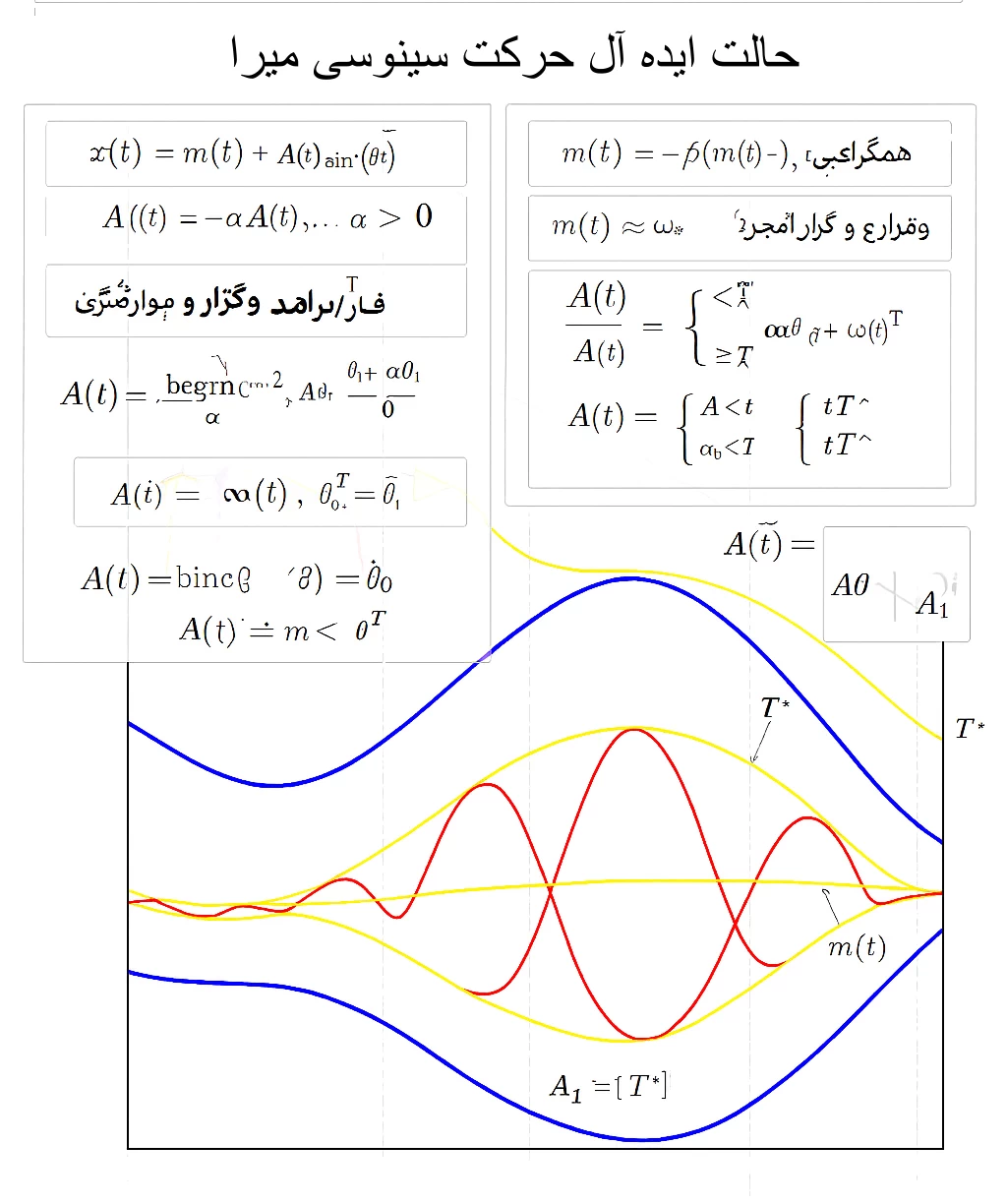
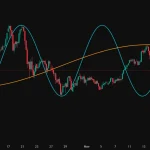
In this article, we examine an oscillatory pattern with decreasing amplitude and central convergence; then, after a sudden transition, a new cycle with larger amplitude begins.
Main Idea: The oscillation amplitude decreases and the mean converges to the center; with a regime change, the amplitude (and sometimes frequency) jumps, forming a new larger cycle.
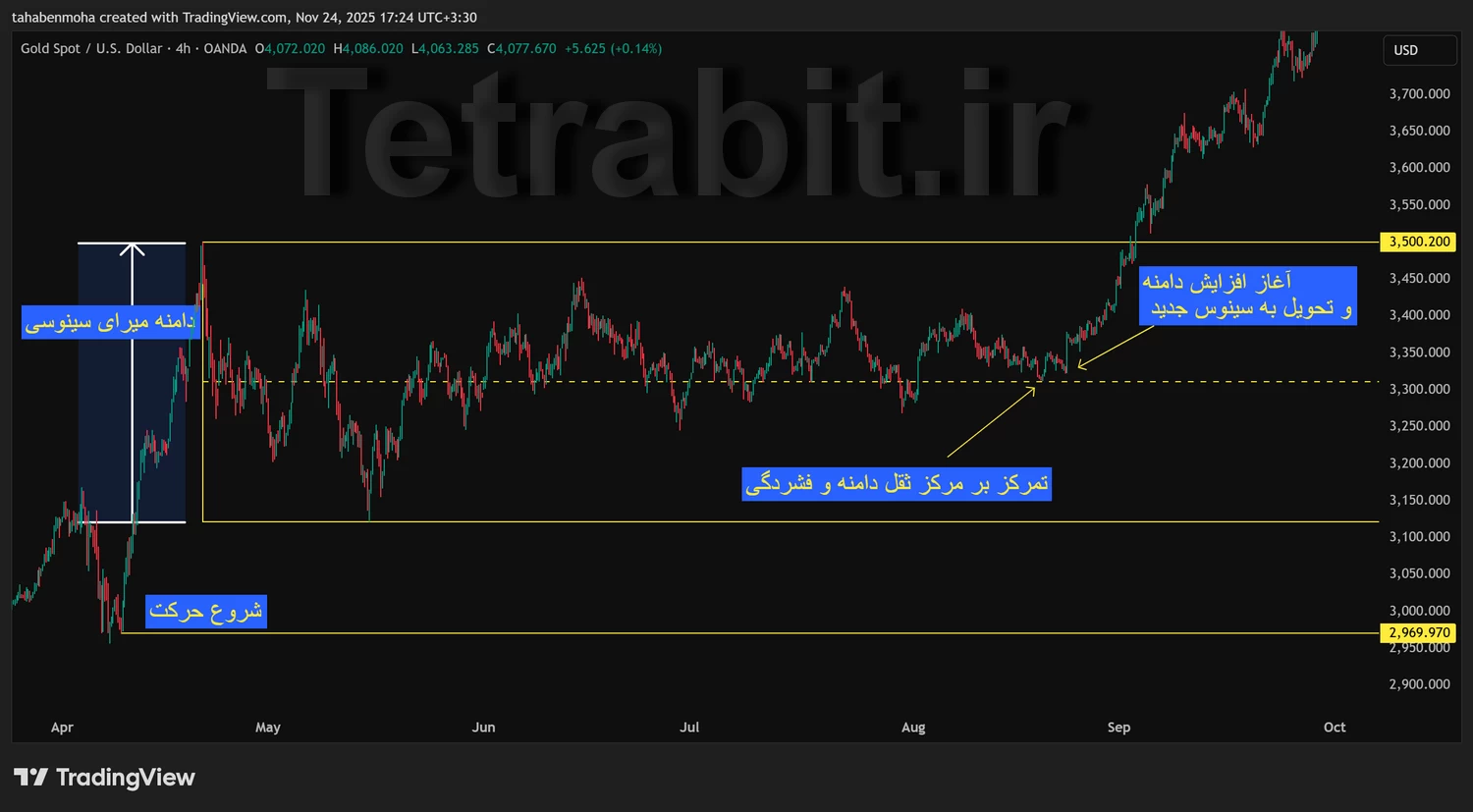
Example on Gold
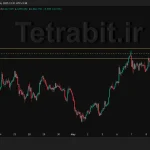
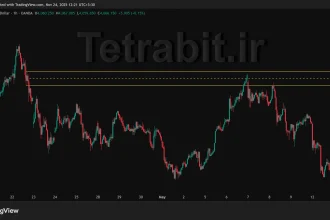
Compression box between 3125–3500; amplitude expansion and breakout above 3500 indicate transition.
Chart Interpretation: The amplitude shrinks during compression and focuses around the center; the upward breakout signals the start of a larger cycle.
Mathematical Form of Time Series with Variable Amplitude and Mean
The base model for an oscillatory series with amplitude and mean modulation:
Transition Model at Time \(T^*\):
\[
A(t) =
\begin{cases}
A_0 e^{-\alpha t} & t < T^* \\
A_1 & t \ge T^*
\end{cases}
\qquad
\omega(t) =
\begin{cases}
\omega_0 & t < T^* \\
\omega_1 & t \ge T^*
\end{cases}
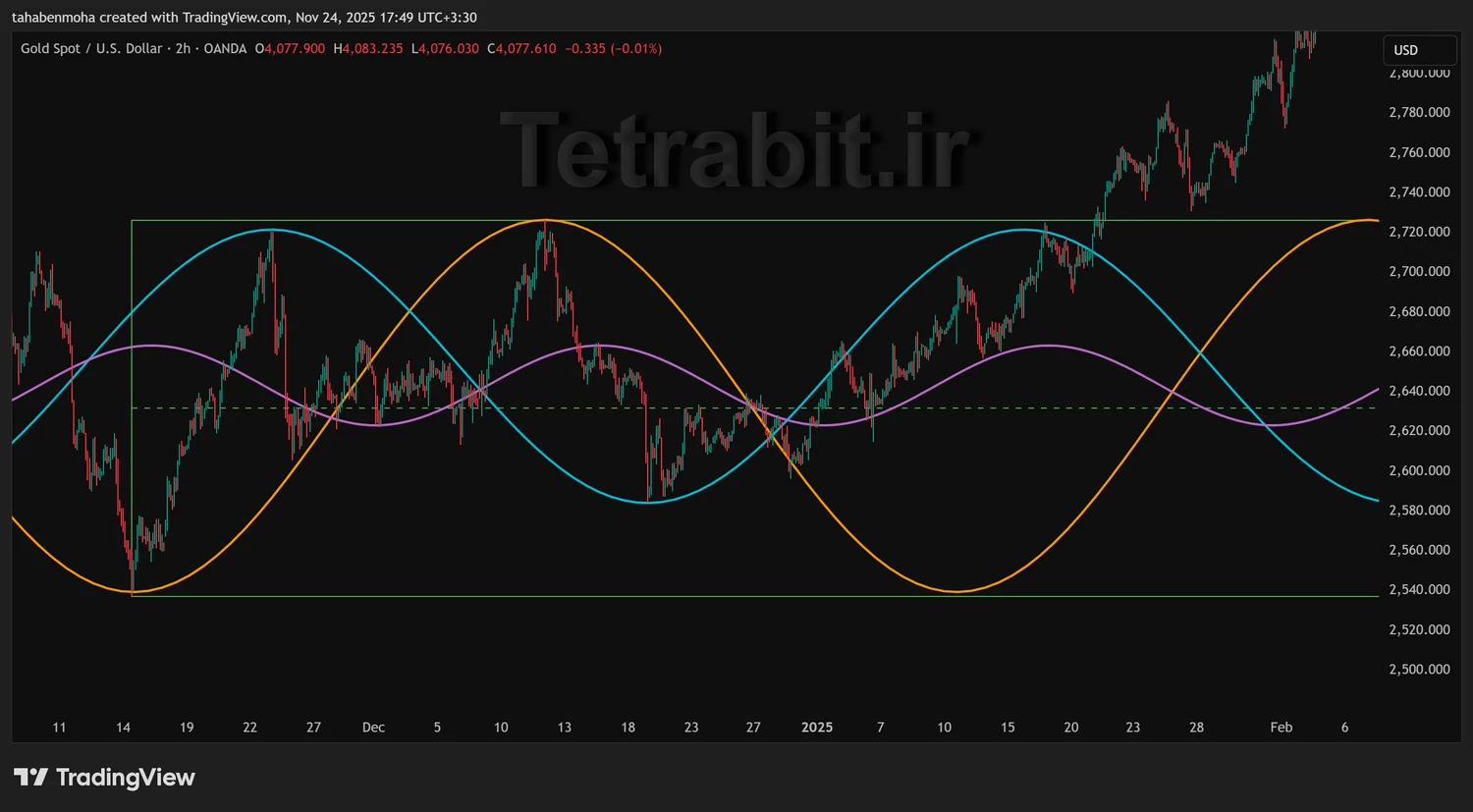
\]Gold chart showing transition from damped amplitude to larger amplitude after breakout.
Estimation and Visualization Strategies on Live Charts
Simple Range Envelope: Use central moving average \(m(t)\) and estimated amplitude \(A(t)\) via ATR or standard deviation; display \(x_\pm(t) = m(t) \pm A(t)\).
Change Point Detection: Monitor persistent jumps in \(A(t)\) or variance; mark \(T^*\) when amplitude expansion continues for several candles.
Validation: Compare pre/post \(T^*\) with metrics like power, RMS, and effective amplitude to avoid false detections.
Execution Parameters: Window length, type of average (EMA/SMA), threshold coefficient for amplitude jump, and minimum candle persistence.
Simple Summary for Traders
When the oscillation amplitude decreases and prices fluctuate within a narrow band, the market has entered a “compression” phase. This compression usually precedes a major move. In the gold chart, we saw that after a calm period, price suddenly broke out of the compression zone with strength and its oscillation amplitude increased. This means the market entered a new, volatile cycle — which can provide good opportunities for entry or exit.