


Time Theory in Ichimoku: The Hidden Heart of Market Analysis
Most sources focus on Tenkan-sen, Kijun-sen, Kumo, and Chikou Span, while Time Theory is often overlooked.
This article takes an educational and practical approach to explain Time Theory from fundamentals to execution, and shows how it integrates with other Ichimoku components and price action.
Introduction
The creator of Ichimoku, Goichi Hosoda, concluded after years of research on Japanese markets that price movements follow recurring time rhythms in addition to price patterns.
He introduced the key numbers 9, 26, and 52 as the pillars of time cycles—numbers that are still used in Ichimoku’s default settings today.
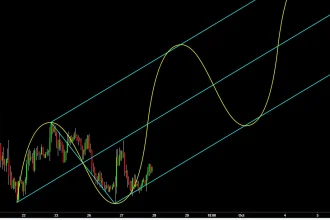
Time Theory is based on the idea that at specific time intervals, the probability of phase shifts, pauses, or acceleration in price movement increases.
Therefore, traders can define not only price targets but also time targets to improve the quality of entry and exit decisions.
The Philosophy of Time Theory
Time Theory suggests that markets tend to change behavior at specific time points. This change may appear as a trend reversal, entry into consolidation, or even structural breakout.
Hosoda considered time as equal in importance to price: when price reaches a key level but the time cycle is not yet complete, continuation is likely; and when the time cycle completes—even if price seems aligned—phase change becomes probable.
The practical philosophy in daily trading is simple: start counting from a valid high or low, and at key time points, evaluate price behavior using Kumo, Kijun, and Chikou Span.
You’ll find that the convergence of “sensitive time” with “sensitive location” is one of the strongest decision-making triggers.
Primary and Secondary Cycles in Time Theory
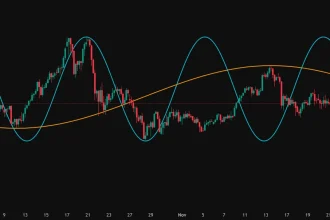
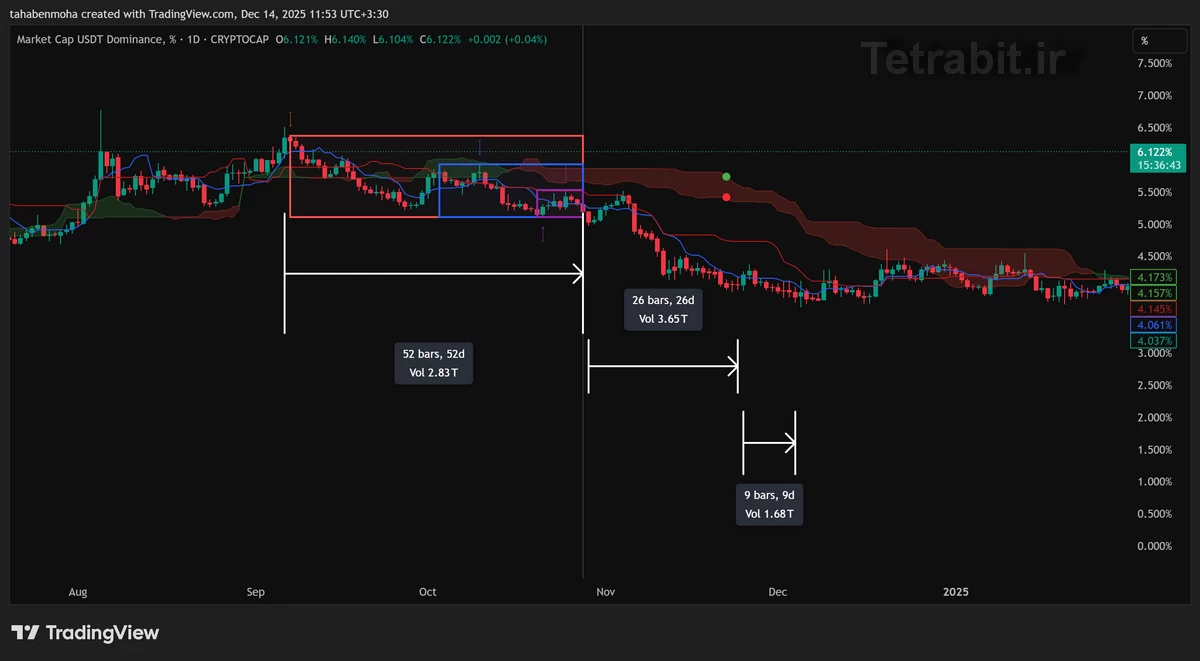
The three key numbers in Time Theory are 9, 26, and 52—representing short-term, medium-term, and long-term cycles respectively.
In practice, traders also combine these cycles to identify high-risk or high-opportunity time zones with greater precision.
- 9-Candle Cycle: Short-term cycle; most corrections, brief pauses, and fast changes occur here.
- 26-Candle Cycle: Medium-term cycle; many major waves and serious consolidation phases form around this number.
- 52-Candle Cycle: Long-term cycle; large reversals, structural changes, and trend phase shifts are more evident here.
Combining cycles leads to secondary intervals: for example, 9+26=35, 26+52=78, and even 52+52=104.
These intervals gain practical importance in certain markets—especially assets with seasonal or event-driven cycles.
The goal of counting is to find “time anchors” that, alone or in convergence with price elements, increase the likelihood of behavioral shifts.
Proper Method for Candle Counting
The starting point for counting must be a valid high or low—confirmed by structural break, divergence, or multi-timeframe validation.
From that point, count each candle sequentially until reaching the key numbers.
At candles 9, 26, and 52, avoid impulsive decisions and first assess the “context”: where is the Kumo? What does Kijun-sen indicate? What is Chikou Span’s position relative to past price?
- Define the anchor point: Choose a valid high or low.
- Sequential counting: Count candles until reaching 9, 26, 52 and secondary combinations.
- Check convergence: Evaluate Kumo, Kijun-sen, Tenkan-sen, and Chikou Span at those candles.
- Confirm with price action: Look for candlestick patterns (engulfing, pin bar), imbalance candles, and liquidity zones.
The subtle point is that Time Theory is probabilistic—not deterministic.
Therefore, each sensitive time point should align with sensitive locations (Kumo edge, flat Kijun, price gaps, liquidity zones) to enhance decision quality.
Conceptual Example: Application in Bitcoin
Suppose Bitcoin begins an upward move from a major low.
At candle 9, we usually see a pause or light correction.
At candle 26, the market enters a consolidation or decision phase—often where Kumo or Kijun become more active.
At candle 52, we expect either the main wave to complete or a meaningful phase shift—provided there is spatial convergence with Ichimoku elements.
If at candle 26, price touches the upper edge of the Kumo and Chikou Span aligns with a sensitive past level, the market is likely approaching a major decision.
Blind entry or exit here is illogical; instead, wait for price action confirmation and valid breakout.
Time Theory tells you the time is sensitive, but “how” to enter must be answered by price structure and risk management.
Combining Time Theory with Kumo
Kumo represents future market equilibrium—where Span A and Span B project potential support and resistance zones with time shift.
When sensitive time candles align with Kumo edges, the probability of strong market reaction increases.
The convergence of “cycle completion” with “Kumo edge” is one of the strongest signals for phase change or new wave initiation.
- Time + Location: Candle 26 or 52 touching Kumo is a serious alert for closer monitoring.
- Kumo thickness: Thick Kumo is a stronger barrier; thin Kumo suggests easier passage.
- Span slope direction: Alignment of Span A slope with trend direction facilitates breakout; divergence warns of reversal.
The Role of Kijun-sen and Tenkan-sen in Time Theory
Kijun-sen, as the medium-term equilibrium line, when flat, often indicates a zone the market tends to revisit.
If a “sensitive time” coincides with a “flat Kijun,” the likelihood of price attraction to that zone increases.
Tenkan-sen, as the short-term average, often provides clues about speed and sufficiency of movement near candles 9 and related combinations.
In practice, convergence of candle 26 with a return to Kijun or contact with a sloped Tenkan can clarify the difference between “trend continuation” and “consolidation/reversal.”
Time Theory highlights these points as “decision windows” so the trader can prepare for rational response.
Time Theory and Price Action
Price action gives you structure, and Time Theory gives you rhythm.
When you know you’re at candle 26 or 52, you expect reactions to be more meaningful.
Therefore, patterns like engulfing, pin bar with notable volume, or valid breakout in these windows carry more weight.
If these events occur at liquidity zones, signal quality increases.
- Signal alignment: Sensitive time + Kumo/Kijun + candlestick pattern = high-quality convergence.
- Error filter: If time is sensitive but location or confirmation pattern is missing, wait.
- Time target: Instead of just price, define expectation “until candle X” and monitor behavior.
Multi-layer Risk Management with Time Axis
Time Theory also adds depth to risk management. When entering sensitive time windows, you can reduce position size, tighten stop-loss, or lock in part of the profit. If your strategy includes time targets, expectation management and avoiding greed become more realistic.

- Reduce size in sensitive windows: Sudden volatility is more likely.
- Active stop-loss adjustment: Based on reactions to Kumo/Kijun at key candles.
- Partial exits: Alongside completion of parts of the time cycle.
Limitations and Common Mistakes
The main limitation of Time Theory is that it is not absolute; markets may shorten or extend cycles, especially during news events or highly algorithmic environments. Choosing an invalid anchor point distorts the entire count. If your chosen high/low is not confirmed by multi-timeframe structure, conclusions will be fragile.
- Weak anchor point: Avoid choosing minor or noisy highs/lows.
- Ignoring location: Time without location (Kumo/Kijun/liquidity) increases error probability.
- Rushed interpretation: Do not neglect price action and volume confirmation.
Step-by-Step Practical Framework
- Find the anchor: Identify a valid high/low with structural and multi-timeframe confirmation.
- Counting: Count candles up to 9, 26, 52 and secondary combinations.
- Map location: Identify Kumo edges, flat Kijun, and liquidity zones.
- Confirmation: At sensitive candles, check candlestick patterns and volume.
- Decision: Enter/exit only at convergence of time–location–price action.
- Management: Adjust position size and stop-loss according to time windows.
Sample Strategy: Time + Kumo + Liquidity
This strategy is designed to identify high-probability points:
Steps
- Start from major high/low: Define anchor and begin counting.
- Monitor candle 26: Around 26, identify liquidity zones (stop clusters, local highs/lows).
- Interaction with Kumo: If price touches Kumo edge and liquidity is nearby, prepare for decision.
- Price action confirmation: Look for valid breakout, engulfing, or rejection at that zone.
- Entry/Exit: Execute with risk management and define time target (e.g., until candle 35 or 52).
The advantage of this approach is that it does not only consider “when” but also “where” and “how.” Thus scattered signals are turned into a coherent set.
Advanced and Multi-timeframe Notes
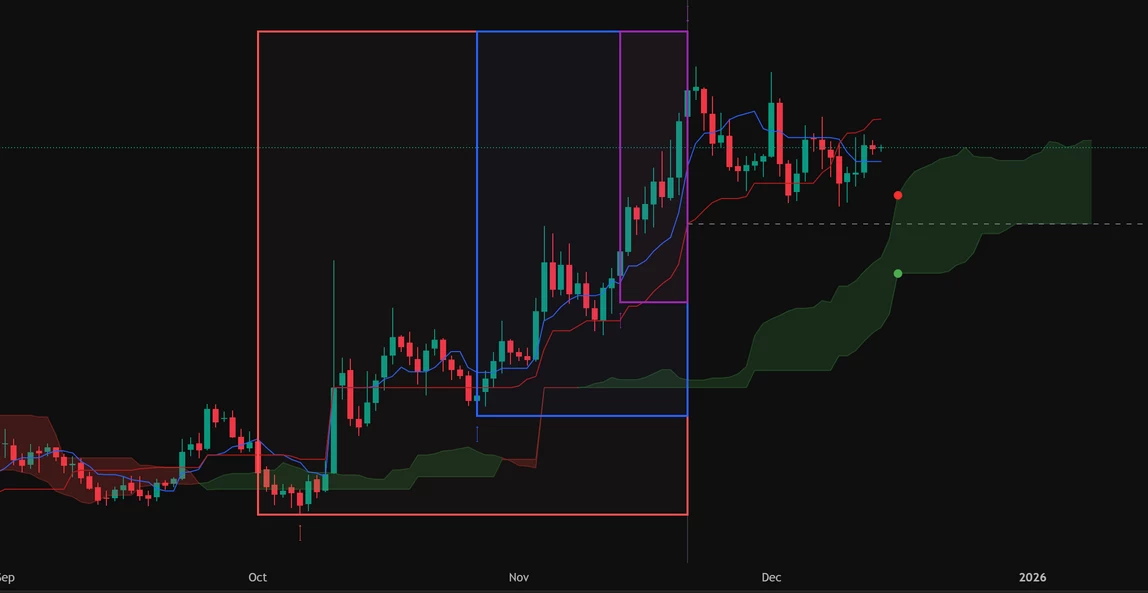
Time Theory is often more stable in higher timeframes (daily, weekly). It is recommended to count in the anchor timeframe (e.g., daily) and look for entry triggers in lower timeframes (4h/1h). Convergence of sensitive candles in higher timeframe with precise reactions in lower timeframe significantly improves entry quality.
- Anchor high, trigger low: Measure time in higher timeframe, enter with price action in lower.
- Cross-time convergence: If daily candle 26 aligns with 4h Kumo, it is a strong alert.
- Asset adaptation: Some instruments have different cycles; be data-driven and calibrate secondary intervals.
Conclusion
Ichimoku Time Theory is the hidden heart of this system; by counting candles at key numbers 9, 26, and 52, sensitive time windows are revealed. When these sensitive times align with sensitive locations (Kumo, flat Kijun, liquidity zones), the probability of phase change or new wave formation increases significantly. Adding price action confirmation and multi-layer risk management builds a coherent and realistic decision-making framework.
For traders, serious attention to Time Theory is a competitive advantage, as it has rarely been explored in depth. When combined with personal observation, backtesting, and adaptation to each market’s nature, this knowledge becomes a practical and impactful tool. From now on, alongside price targets, include time targets in your trading plan and look at the market not only in terms of “where” but also “when.”