


Price Reversion to the MACD Zero Line — Scientific, Geometric, and Statistical Analysis
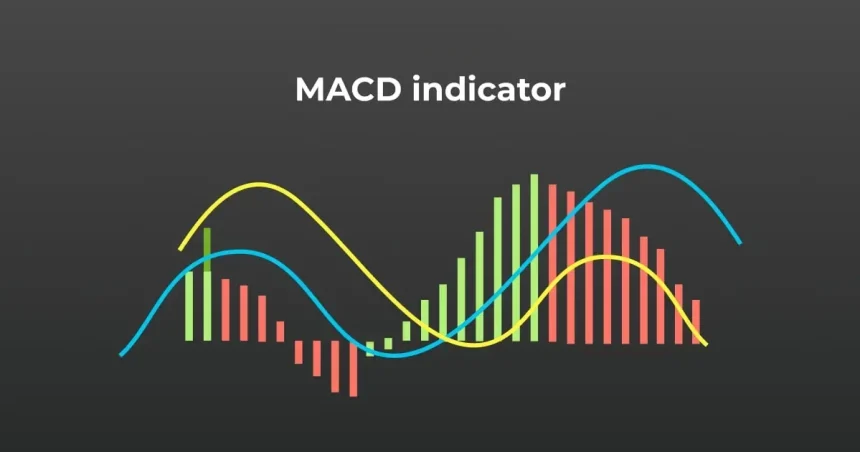
The MACD indicator is a widely used tool in technical analysis that combines exponential moving averages to reveal momentum and trend direction. A notable phenomenon in MACD behavior is the tendency of price to revert to the zero line during market cycles. This article explores the scientific, mathematical, geometric, and statistical aspects of this reversion and provides a practical method for approximating the zero line when numerical scales are not displayed.
Mathematical definition of MACD and the zero line
The MACD is defined as:
\[
\text{MACD}(t) = \text{EMA}_{\text{fast}}(t) – \text{EMA}_{\text{slow}}(t)
\]
In the standard setting:
\[
\text{EMA}_{\text{fast}} = \text{EMA}_{12}, \quad \text{EMA}_{\text{slow}} = \text{EMA}_{26}
\]
The zero line occurs when:
\[
\text{EMA}_{12}(t) = \text{EMA}_{26}(t) \Rightarrow \text{MACD}(t) = 0
\]
The MACD histogram is defined as the difference between MACD and its signal line (a 9-period EMA of MACD):
\[
\text{Hist}(t) = \text{MACD}(t) – \text{Signal}(t), \qquad \text{Signal}(t) = \text{EMA}_{9}\big(\text{MACD}(t)\big)
\]
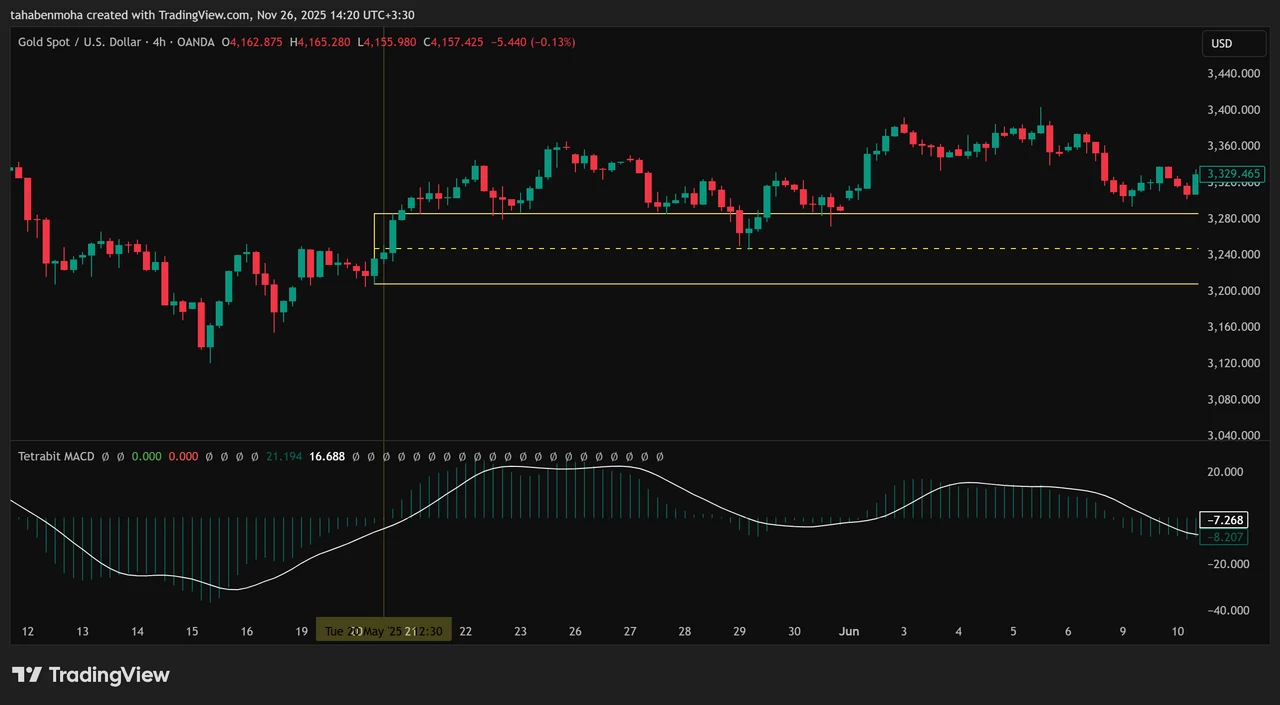
Why does MACD revert to zero?
- Convergence of averages: As momentum weakens or corrections occur, the fast EMA converges toward the slow EMA, reducing their difference.
- Temporary equilibrium: Reversion to zero reflects a short-term balance between buying and selling pressure.
- Oscillatory behavior: MACD acts like an oscillator around zero, naturally crossing and reverting during cycles.
Geometric method for approximating the zero line
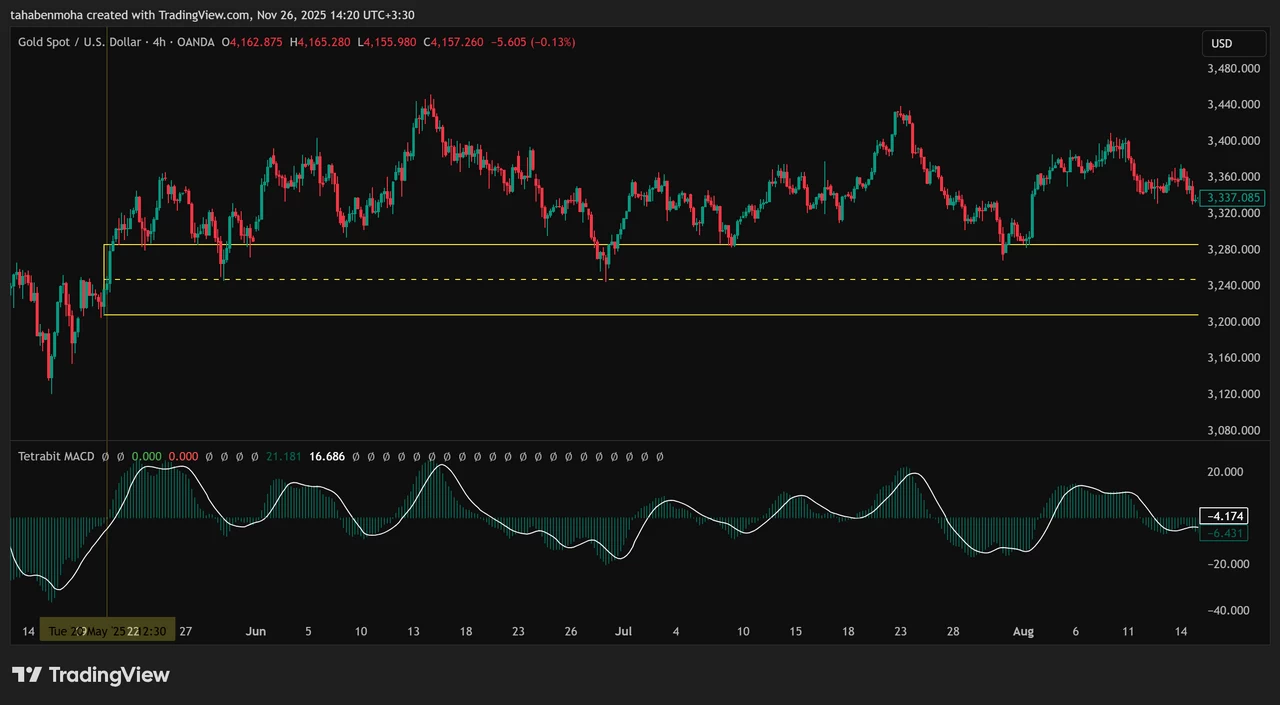
When the numerical scale of MACD is not available, a geometric approach can be applied:
- Identify the region near zero: Focus on the area where histogram bars are shortest.
- Select three bars: The minimum bar plus one before and one after to stabilize the region.
- Draw a rectangle: From the highest to the lowest value of those bars.
- Use the midpoint: The center line of the rectangle approximates the zero line.
Mathematical model of this approximation:
\[
\text{Zero}_{\text{approx}} = \frac{H + L}{2}
\]
where \(H\) and \(L\) are the maximum and minimum histogram values in the selected region.
Practical applications in technical analysis
- Trend phase confirmation: Crossing the zero line can confirm the start or end of a momentum wave.
- Trade management: Approaching zero can be used to reduce risk or adjust stop-loss levels.
- Divergences: Near zero, price–MACD divergences provide stronger signals of weakness or reversal.
- Multi-timeframe analysis: Signal reliability increases when zero-line crossings align across higher timeframes.
Dynamic analysis of MACD around zero
MACD behavior can be modeled as a simple linear recursive system:
\[
\text{MACD}_{t+1} = \alpha \cdot \text{MACD}_t + \beta \cdot \Delta P_t
\]
Here, \(\alpha \in (0,1)\) is the reversion coefficient and \(\beta\) the sensitivity to price changes \(\Delta P_t\). In low-volatility conditions (\(\Delta P_t \approx 0\)), MACD gradually decays toward zero.
A continuous-time approximation can be expressed as:
\[
\frac{d\,\text{MACD}}{dt} = -\kappa \cdot \text{MACD} + \gamma \cdot \frac{dP}{dt}
\]
With \(\kappa > 0\) as the decay rate and \(\gamma\) as the response to price velocity, the homogeneous solution shows exponential decay toward zero unless sustained price input persists.
Statistical analysis of zero reversion
To empirically measure reversion, extract MACD peak/trough events from historical data (e.g., XAUUSD) and measure the time to the next zero crossing. Useful metrics include:
- Median reversion time: Number of bars from MACD peaks/troughs to zero.
- Timeframe dependency: Higher timeframes revert more slowly but more reliably.
- Trend conditions: In strong trends, reversion is delayed and often coincides with divergence and consolidation.
These statistics can be implemented with Python or R; the outputs inform realistic risk management and entry/exit timing.
Optimizing the geometric method with image algorithms
When MACD’s numerical scale is unavailable, image processing can refine the approximation:
- Detect minimal bars: Identify histogram bars with the smallest height using thresholding and edge detection.
- Pixel averaging: Determine the rectangle midpoint by averaging vertical pixel coordinates.
- Calibration: Estimate pixel-to-value ratios using fixed chart reference points.
The output provides a more stable visual estimate of the MACD zero line and can be adapted to custom WordPress tools.
Advanced trading notes
- Multi-signal filtering: Confirm zero crossings with volume and candlestick structure.
- Indecision zone: Define a narrow band around zero as a no-trade zone to avoid noise.
- Higher timeframe context: Simultaneous zero reversion across timeframes increases the probability of transition phases.
- Risk management: During zero reversion, reduce leverage and adjust stops to prevent cascading losses.
Conclusion
MACD’s reversion to the zero line results from moving average convergence and momentum decay. Through geometric approximation, dynamic modeling, and statistical analysis, this phenomenon can be quantified and applied to trading decisions. Combining these approaches with multi-timeframe confirmation and risk management enhances signal quality and adaptability to changing market conditions.