


Price Modeling with Variable Mass Motion Equation in Financial Markets
variable mass
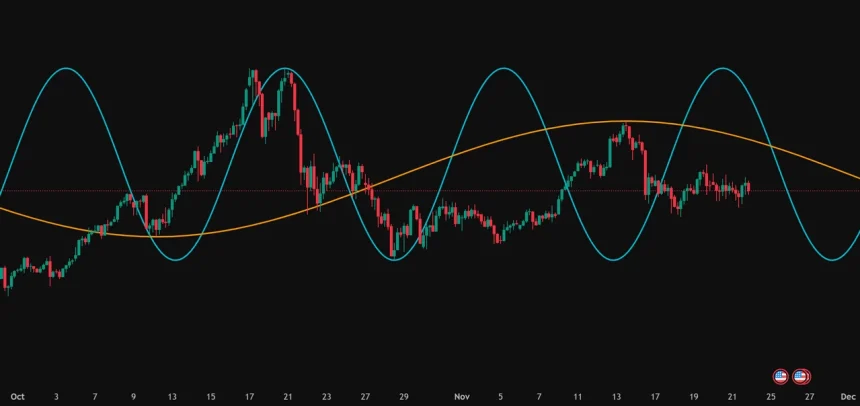
into financial markets, introducing a practical mechanism for constructing the “midline of a sine wave” and extracting targets using the “equal‑area” method.
Motivation and Main Idea
The price behavior of assets is not only a function of past prices; capital inflows and outflows, changes in position size, and liquidity directly affect price acceleration. Using the “variable mass” framework, these effects can be expressed through a motion equation, defining the “midline” as the equilibrium boundary of forces on the chart.
Intuitive view: Price behaves like a body whose mass changes over time; changes in mass (position size/liquidity) exert an effective force on price acceleration.
Injecting Physical Concepts into the Market
- Effective mass: A combination of position size and effective liquidity (volume, open interest, order book depth).
- Price and velocity: Rate of price change:
\( v(t) = \frac{dP}{dt} \) - External forces: News shocks, macro factors, and inter‑asset relationships.
- Marginal effect: Parameter \( u(t) \) representing the intensity of converting size changes into price movement.
Basic Equations of Variable Mass Motion
General form of the motion equation
\[
m(t)\,\frac{dv}{dt} = F_{\text{ext}}(t) + u(t)\,\frac{dm}{dt}
\]
Effective price acceleration
\[
a_{\text{eff}}(t) = \frac{F_{\text{ext}}(t) + u(t)\,\frac{dm}{dt}}{m(t)}
\]
Simplified analytical cases
- When \(u\) is constant and external forces are negligible:
\[
\frac{dv}{dt} \approx \frac{u}{m(t)}\,\frac{dm}{dt}
\]
\[
\Delta v \approx u \,\ln\!\left(\frac{m_0}{m(t)}\right)
\] - With smoothed external forces:
\[
a_{\text{eff}}(t) \approx \frac{\overline{F}_{\text{ext}}(t)}{m(t)} + \frac{u}{m(t)}\,\frac{dm}{dt}
\]
Equal‑Area Method and Calibrated Line Definition
Definition of equal areas
Two time intervals of equal length \( \Delta T \) are selected whose price characteristics are approximately similar:
- Open difference: \( \Delta O = |O_2 – O_1| \le \epsilon_O \)
- Close difference: \( \Delta C = |C_2 – C_1| \le \epsilon_C \)
- Average/range difference: \( \Delta P = |\bar{P}_2 – \bar{P}_1| \le \epsilon_P \)
Constructing the midline
\[
a_{\text{eff}}(t^*) = 0 \quad \Rightarrow \quad F_{\text{ext}}(t^*) + u\,\frac{dm}{dt}\bigg|_{t^*} = 0
\]
Cut–Shift–Repeat cycle and target extraction
- Trigger: The first candle that cuts the calibrated line.
- Shift areas: The areas are shifted up to the cutting candle.
- Recalculation: A new calibrated line is extracted.
- Target: The new line is considered the target of the current cycle.
- Multi‑timeframe: Convergence of targets strengthens signal validity.
Execution Algorithm and Calibration
- Effective mass:
\[
m(t) = \alpha \cdot \text{Volume}(t) + \beta \cdot \text{OpenInterest}(t) + \gamma \cdot \text{OrderBookDepth}(t)
\] - Rate of mass change:
\[
\frac{dm}{dt} \approx m(t) – m(t-1)
\] - Marginal effect \( u(t) \): General parameter converting size change into price movement.
- External force \( F_{\text{ext}}(t) \): In absence of news data, use inter‑market indicators.
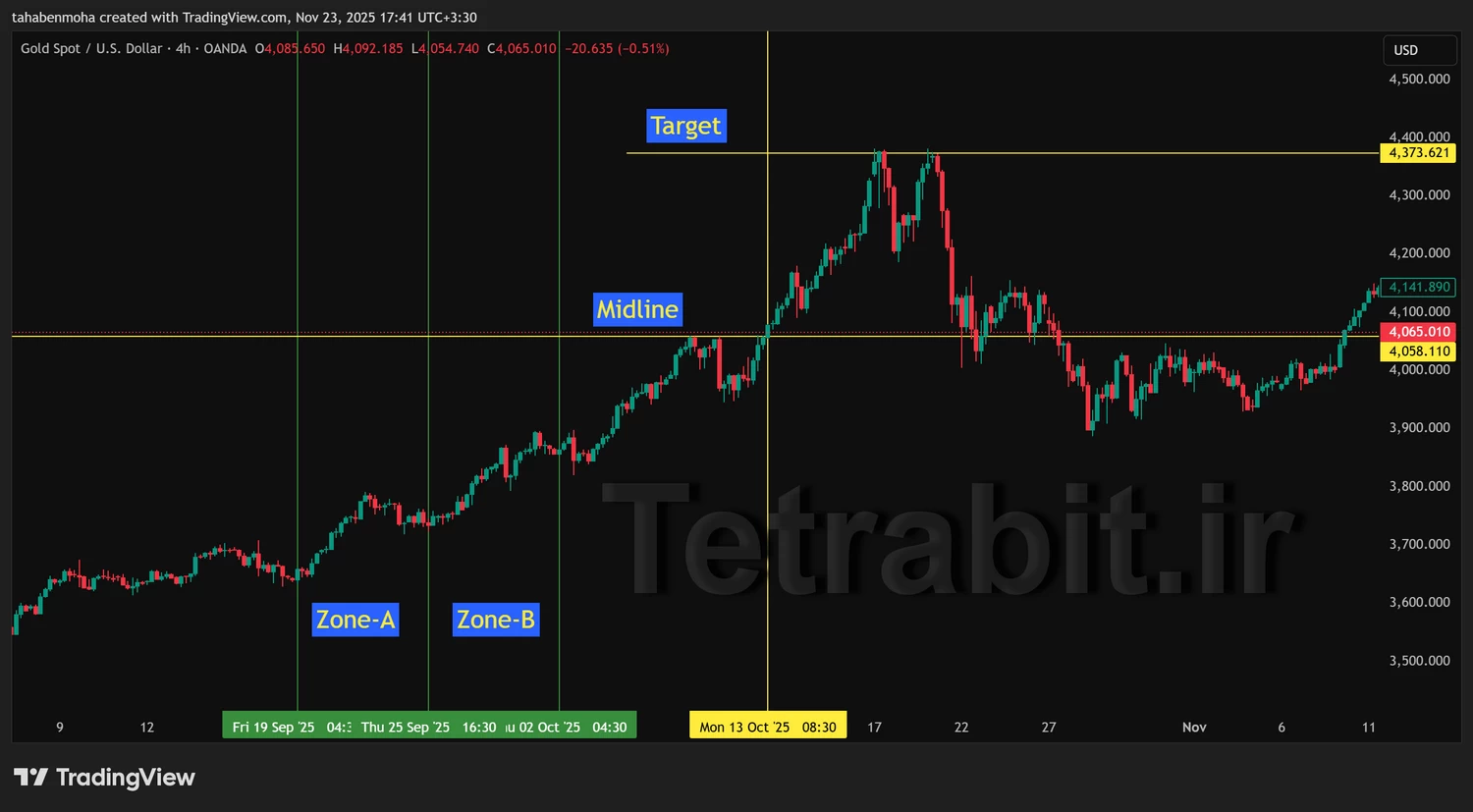
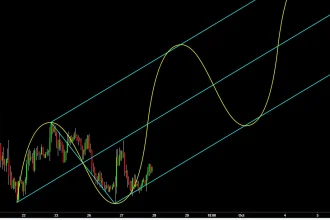
Case Study: Gold (XAU/USD) on 4‑Hour Timeframe