


Crypto Transfer Fees in 2026: A Comprehensive Guide and Future Outlook
Crypto transfer fees are one of the most important factors in blockchain user experience. This article reviews crypto transfer fees across major networks, explains their history and calculation mechanisms, and predicts their future in 2026.

History of Blockchain Fees
At the beginning of Bitcoin, fees were negligible because the number of transactions was low. As popularity grew, block capacity limits caused fees to rise. This led to the creation of new networks such as Tron and Ripple, aiming to reduce transfer costs and increase speed.
Mechanism of Crypto Transfer Fee Calculation
- Bitcoin: Fees are calculated based on transaction data size (bytes).
- Ethereum: Fees are determined by Gas and the real-time gas price.
- Ripple: Fixed and very small fee (~$0.0002), burned to prevent spam.
- Tron: Network fee is negligible (less than $0.01), but for Tether exchanges usually apply a fixed $1 fee.
- Binance Smart Chain: Low fees based on Gas, similar to Ethereum but with higher capacity.
Comparison of Major Networks (2026)
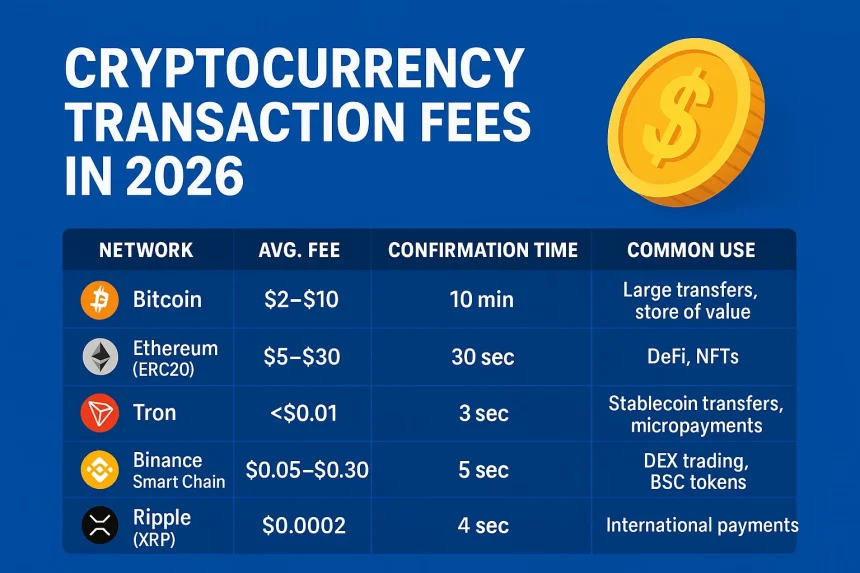
Network | Average Fee | Confirmation Speed | Common Use |
|---|---|---|---|
Bitcoin (BTC) | $2–$10 depending on congestion | ~10 minutes | Large transfers, store of value |
Ethereum (ERC20) | $5–$30 (volatile) | 30 seconds | DeFi, NFT, smart contracts |
Tron (TRC20) | 3 seconds | Tether transfers, micro-payments | |
Binance Smart Chain (BEP20) | $0.05–$0.30 | 5 seconds | DEX trades, BSC tokens |
Ripple (XRP) | $0.0002 | 4 seconds | International payments |
Sources: Coinpaper, Bitget Academy, CoinGape
Risks and Key Points
- Wrong network selection: Sending USDT ERC20 to a TRC20-only wallet results in asset loss.
- Hidden fees: Some exchanges charge extra withdrawal fees beyond network fees.
- High volatility: Ethereum fees spike during major events like NFT launches.
Predictions for Crypto Transfer Fees in 2026
- Bitcoin: Average fees may rise due to institutional adoption, but Lightning keeps micro-transfers cheap.
- Ethereum: Fees remain volatile, but Layer 2 solutions (Arbitrum, Optimism, zkSync) could reduce costs by 40–60%.
- Tron: Still the cheapest option for stablecoin transfers, though exchanges usually apply a fixed $1 fee for Tether.
- Binance Smart Chain: Fees may rise slightly with usage growth but remain far lower than Ethereum.
- Ripple: Likely to maintain ultra-low fees (~$0.0002), especially with expanded banking partnerships.
Overall, average costs are expected to decline in 2026, but DeFi and NFT activity peaks will still cause fee spikes.

Comparison of Normal vs Congested Conditions
Network | Fee in Normal Conditions | Fee in Congested Conditions |
|---|---|---|
Bitcoin | $2–$5 | $10–$20 |
Ethereum | $5–$10 | $30–$80 |
Tron | Almost fixed | |
Binance Smart Chain | $0.1–$0.3 | $1–$2 |
Ripple | $0.0002 | Almost fixed |
Frequently Asked Questions (FAQ)
Which is the cheapest network for USDT transfers?
Tron (TRC20) is cheapest on-chain, but most exchanges apply a fixed $1 fee for Tether.
Why are Ethereum fees high?
Due to heavy demand for DeFi and NFTs, which congests the network.
Is Ripple really fast?
Yes, XRP transactions confirm in ~4 seconds with negligible fees (~$0.0002).
Do exchanges charge extra fees?
Yes, many exchanges add withdrawal fees beyond network fees.
Do Layer 2 solutions reduce costs?
Yes, networks like Arbitrum and Optimism significantly lower Ethereum fees.
Can fees ever be zero?
No, there will always be a small fee to prevent spam.
Conclusion
Crypto transfer fees in 2026 remain a major challenge for users and developers. Bitcoin and Ethereum have higher fees during congestion, while Tron and Ripple stay cheaper and faster. Using Layer 2 solutions and choosing the right network can significantly reduce costs.