

Comprehensive Risk Analysis of Tether (USDT) Collapse and the Probability of Losing Dollar Peg
This article is solely a general analysis. The aim is to clarify structural risks, shock scenarios, monitoring indicators, and risk management strategies for professional market participants.
Executive Summary
Quick Result: A complete collapse of Tether in the short term is unlikely; however, losing the 1:1 peg (Depeg) is more probable under severe market shocks or regulatory constraints. The severity of outcomes depends on reserve composition, access to safe liquidity, and redemption behavior during crises.
- Complete Collapse: Requires simultaneous extreme events such as banking blockage, regulatory seizure or pressure, and market trust breakdown.
- Loss of Peg: Usually temporary; but in major crises it can become deeper and longer-lasting.
- Systemic Impact: Any serious disruption in USDT (Tether) triggers liquidity crises and contagion of sell-off pressure across the crypto market.
What is USDT (Tether) and How Does It Maintain the 1:1 Peg?
Definition: USDT (Tether) is a private stablecoin aiming to keep its value close to 1 USD through backing by a basket of assets.
- Peg Mechanism: Market trust in redemption capability at the issuer and existence of safe reserves (cash, bank deposits, short-term government securities).
- Stabilization Channels: Arbitrage between exchanges, OTC flows, and direct redemption for eligible clients.
- Critical Points: Reserve transparency, credit quality of backing assets, and speed of liquidity access under stress.
Complete Collapse vs. Depeg: Two Different Risks
Complete Collapse (Existential Risk)
- Nature: Permanent halt of operations or redemption, legal/operational breakdown, or irreversible loss of trust.
- Triggers: Broad banking blockage, seizure or freezing of reserve assets, crippling regulatory orders.
- Probability: Lower than Depeg; requires severe and prolonged multi-factor pressure.
Loss of Peg (Depeg)
- Nature: Significant deviation of Tether price from 1 USD for a defined period.
- Triggers: Price crashes, redemption runs, imbalance in on-chain liquidity pools, or delays in liquidity provision.
- Probability: Moderate; rises during crises and is usually corrected by arbitrage and redemption.
Key Risk Channels for Tether
- Reserve Composition: Ratio of highly safe assets (cash, short-term government securities) versus volatile or credit-risk assets. Higher risky share increases sensitivity to shocks.
- Immediate Liquidity: Ability to quickly convert reserves into USD; delays deepen Depeg.
- Transparency and Reporting: Frequency and depth of disclosures, type of verification (attestation/audit), and independent verifiability.
- Regulatory/Banking Risk: Changes in banking access, jurisdictional restrictions, and exposure to sanctions/prosecution.
- Market Liquidity Concentration: Heavy reliance of crypto markets on USDT amplifies contagion during crises.
Historical Behavior and Depeg Episodes
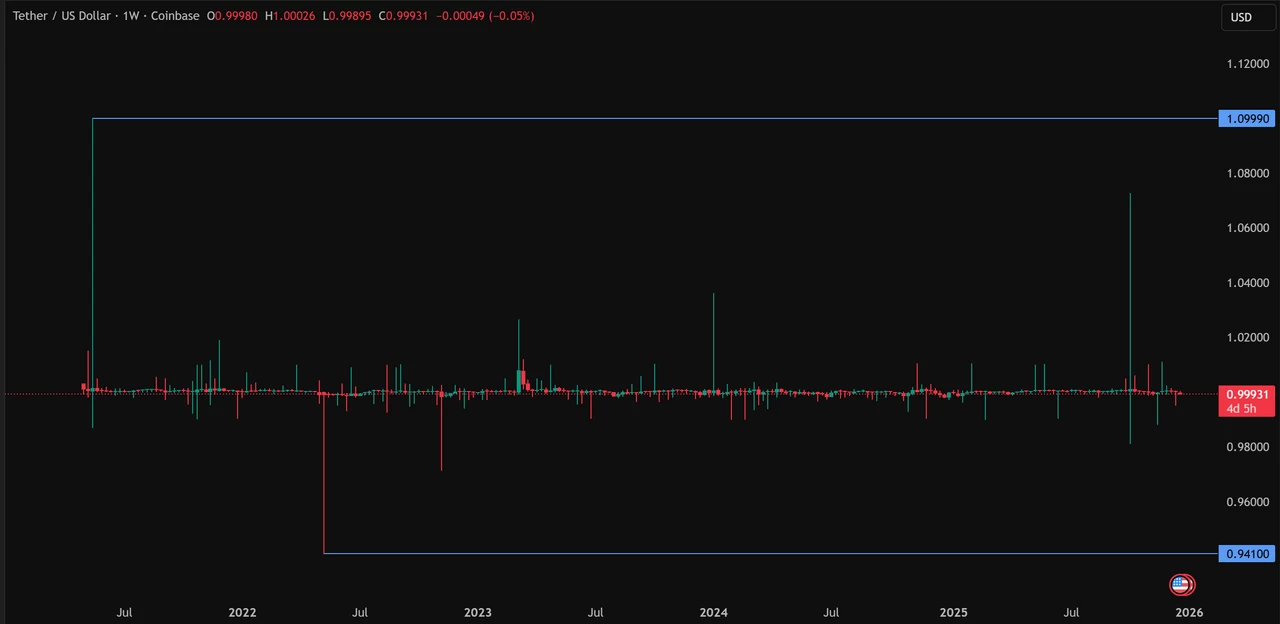
Pattern: Under severe shocks, USDT (Tether) may trade below 1 USD; with liquidity return, arbitrage and redemption usually narrow the gap. Depth and duration of Depeg depend on shock intensity and speed of liquidity provision.
- Experiences: Stablecoin pool imbalances (e.g., Curve) are early signs of stress.
- OTC Role: Professional channels can help stabilize price, but are not publicly accessible.
- Communication Effect: Fast and credible issuer communication reduces sell pressure; ambiguity worsens Depeg.
Stress Scenarios and Implications
1) Severe Crypto Market Crash
- Immediate Effect: Rising redemption demand and risk-off exit; pressure on reserve liquidity.
- Implication: Temporary Depeg likely; severity depends on liquidity speed and crash magnitude.
2) Regulatory or Banking Restrictions
- Immediate Effect: Disruption in direct redemption and banking settlements.
- Implication: Wider deviation of market price from USD, more persistent Depeg risk, or in the worst case, partial halt of operational channels.
3) Reserve Composition Shock
- Immediate Effect: Decline in value or liquidity of higher-risk assets.
- Implication: Weakening of peg safety buffer and increased sensitivity to capital outflows.
4) Redemption Run
- Immediate Effect: Urgent need for liquidity; long queues intensify Depeg.
- Implication: Temporary if liquidity is quickly provided; systemic crisis if liquidity is insufficient.
Practical Monitoring Indicators
- Real-time USDT Price: Track deviation from 1 USD on major exchanges (spot and perpetual), especially during shocks.
- Pool Imbalances: Stablecoin pool ratios on platforms like Curve/Uniswap.
- Reserve Reports: Frequency and detail of disclosures; ratio of safe to volatile assets.
- Redemption Volume and Speed: Signs of rising requests and settlement times.
- OTC Spreads: Indicator of stress or calm in professional liquidity.
Comparison of USDT, USDC, and DAI
Key Feature | USDT (Tether) | USDC (Circle) | DAI (MakerDAO) |
|---|---|---|---|
Type of Backing | Basket of traditional and sometimes volatile assets | Cash and short-term government securities | Crypto collateral and tokenized assets |
Peg Mechanism | Trust in reserves + issuer redemption | Trust in safe reserves + strong redemption | Collateral management and protocol stability fees |
Transparency | Periodic disclosure with uneven depth | Regular disclosure with more detail | On-chain with open governance |
Regulatory Risk | Medium to high, jurisdiction-dependent | High but under stricter frameworks | Smart contract and crypto market risk |
Sensitivity to Crypto Crash | Moderate; depends on reserve composition | Lower; due to safer reserves | High; depends on health of crypto collateral |
Summary: In fiat liquidity crises, USDC usually shows stronger peg stability; DAI is sensitive to crypto collateral conditions; and USDT’s performance depends on reserve composition and banking access.
Risk Management Strategies for Traders and Issuers
- Stablecoin Diversification: Holding a mix of USDT, USDC, and DAI to reduce single-point risk.
- Diversified Settlement Channels: Maintaining access to exchange, OTC, and on-chain channels; practicing alternative routes during crises.
- Warning Thresholds: Defining limits for Depeg (e.g., below 0.99) and executing automatic risk reduction.
- Liquidity Buffer: Keeping part of capital in highly safe fiat instruments to cover urgent needs.
- Continuous Monitoring: Tracking spreads, pool imbalances, reserve reports, and regulatory news.
Conclusion
Final Verdict: A complete collapse of USDT (Tether) is a tail risk with low probability, requiring severe multi-factor pressure; losing the 1:1 peg is more probable and usually temporary. Practical preparedness, diversification, and smart monitoring of indicators are the best defense against structural risks and market shocks.