


How to Visualize MACD Logic Directly on the Price Chart Using EMAs
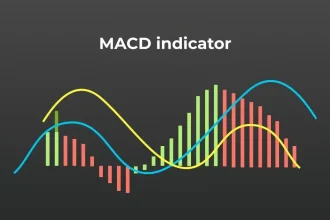
a histogram, a MACD line, and a signal line.
But what if we could project MACD’s logic
directly onto the price chart itself? What if, without looking at the indicator window,
we could understand what MACD is saying just by watching the behavior of moving averages
and how price interacts with them?In this article, we explain step by step how to translate MACD logic
onto the price chart using several Exponential Moving Averages (EMAs),
so that you can see the “MACD zero line” and its changes as lines on the chart,
not only in a separate indicator pane.
1. What does MACD actually show us?
In its simplest form, MACD is the difference between two
Exponential Moving Averages, usually
EMA 12 and EMA 26. When the faster EMA (12) is above the slower EMA (26),
MACD is positive; when it is below, MACD is negative. Therefore:
- Positive MACD → temporary dominance of buyers over sellers.
- Negative MACD → temporary dominance of sellers over buyers.
- MACD crossing the zero line → the moment when 12 and 26 coincide and a relative balance is formed.
So the “MACD zero line” is a very important concept: it is the point where the forces
of both sides of the market temporarily come into balance.
If we can see this zero level on the price chart as a line or zone,
our understanding of market behavior becomes much deeper.
2. The idea of a “virtual zero”: translating MACD onto the price chart
To project MACD logic onto the price chart, we use a simple idea:
between the two main EMAs (for example 12 and 26), we place a third EMA
that acts as a “central rail” or a “virtual MACD zero line.”
In the structure we are discussing:
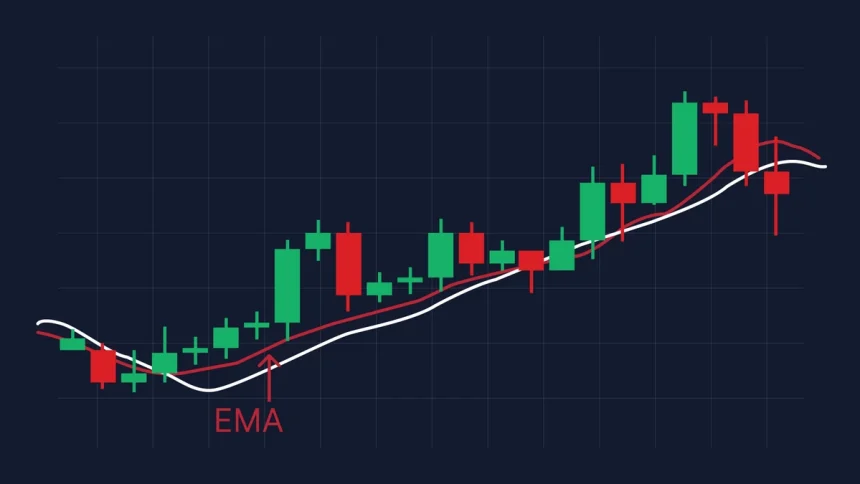
- EMA 12 → the faster average, sensitive to short-term changes.
- EMA 26 → the slower average, representing the medium-term trend.
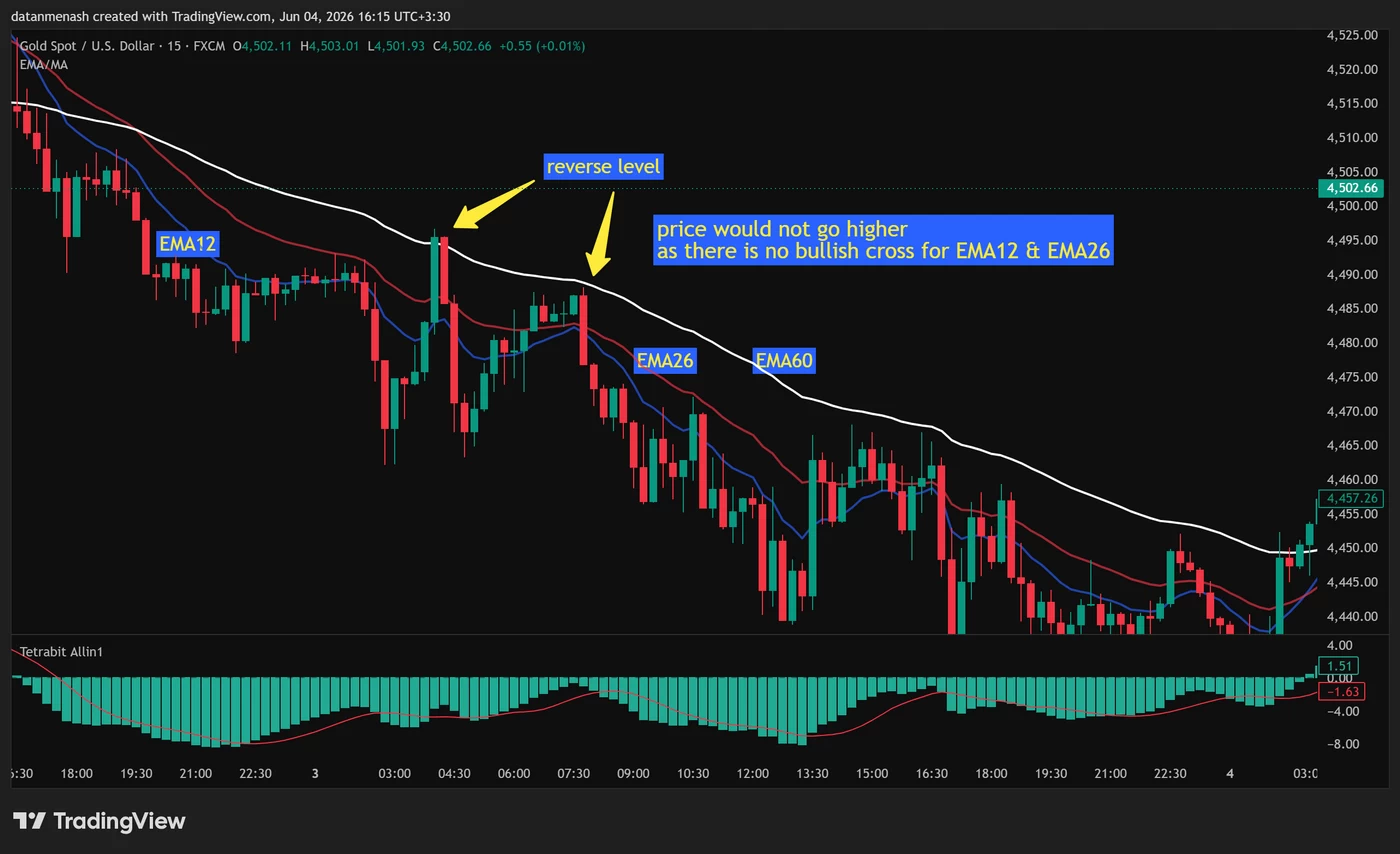
- EMA 60 → the middle line that can be considered an approximation of the “MACD 12–26 zero line.”
This means that instead of only looking at the MACD histogram, we visualize the concept of
“MACD approaching zero” through price interacting with EMA 60 on the chart.
Every time price reaches this line, it is effectively approaching a zone where
a new balance between EMA 12 and EMA 26 is forming.
3. The role of the distance between EMA 12 and EMA 26
A very important point that is often overlooked is the distance between EMA 12 and EMA 26.
When these two lines are very close to each other, the market is in a state of hesitation and minor noise;
any small move can make 12 go slightly above or below 26 without the underlying trend
actually changing. In such conditions, any signal based purely on a “cross”
or a simple touch of price to a line will be full of noise and errors.
But when the distance between 12 and 26 is clear and noticeable, it means:
- The previous trend has gained momentum and has a clear direction.
- The market has moved out of a neutral, indecisive phase.
- Each interaction of price with the “virtual zero” (e.g. EMA 60) can carry deeper meaning.
Therefore, for our signals to be logical and reliable, we should only pay attention
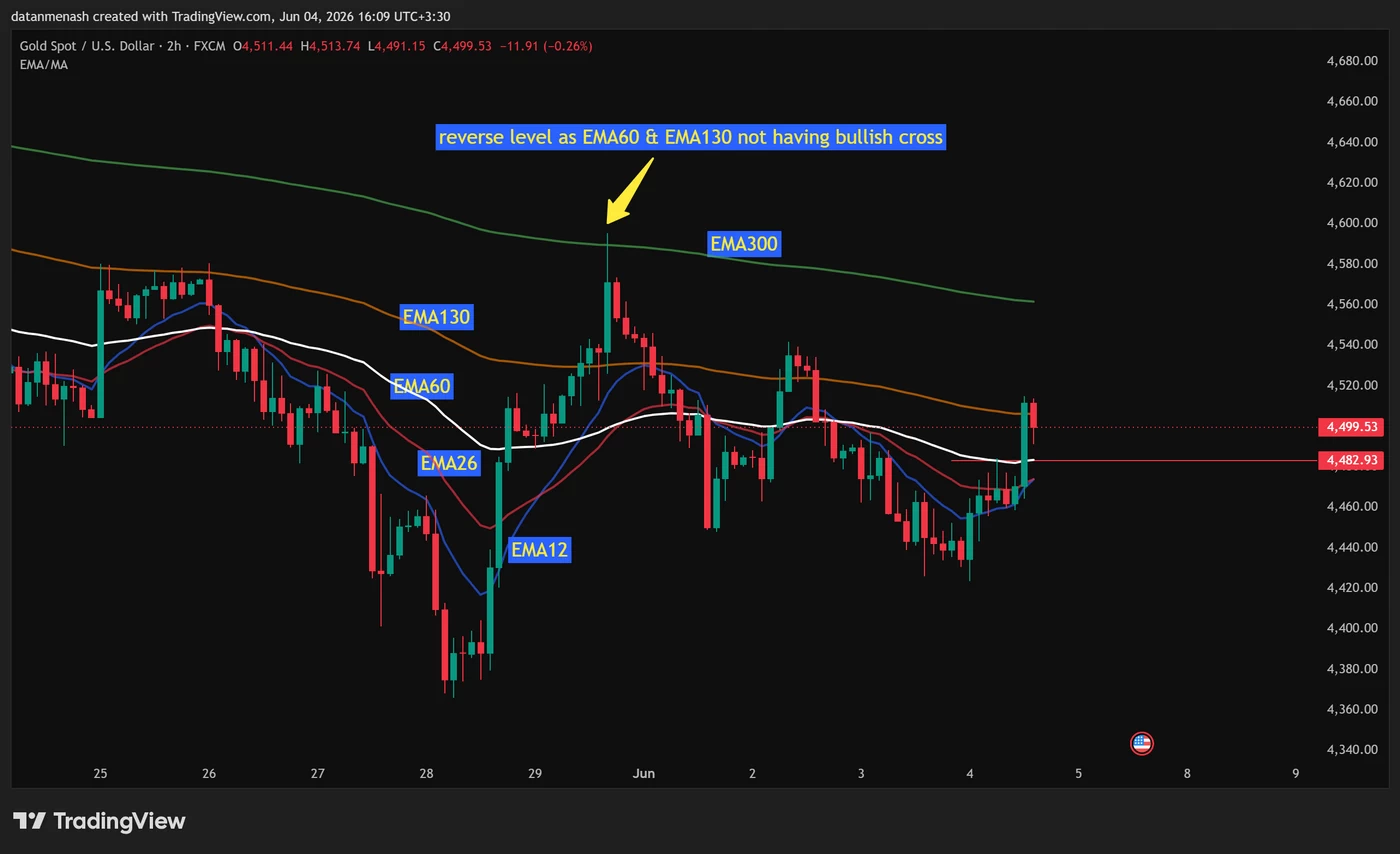
to price touching EMA 60 when the distance between EMA 12 and EMA 26 is sufficiently large—
a “visible distance” that you can easily recognize by eye, just like in the example
on the 2-hour gold chart.
4. Price interaction with EMA 60: a practical translation of the MACD zero line
Now that we know EMA 60 acts as the virtual MACD 12–26 zero line, the key question is:
When is price interaction with this line important for us?
The answer lies in the combination of three factors:
- A visible distance between EMA 12 and EMA 26: meaning the prior trend has built up strength.
- Actual contact of price with EMA 60: not just getting close, but truly touching or crossing the line.
- The relative position of EMA 12 to EMA 26: to determine whether we expect a reversal upward or downward.
When EMA 12 is below EMA 26 and the distance between them is large, it indicates a dominant downtrend.
If, in this situation, price reaches EMA 60, this interaction can be interpreted as MACD approaching zero
and a possible end of a corrective wave or the beginning of a new move in the dominant direction.
Conversely, when EMA 12 is above EMA 26 and the distance is large, price touching EMA 60
can signal the end of a downward correction within an ongoing uptrend.
5. Why is “real contact” more important than the candle close?
In this logic, the emphasis is on the idea that it is enough for price to reach the line;
it does not matter where the candle closes. The reasoning behind this is:
- During the formation of a candle, the market repeatedly tests the strength of buyers and sellers.
- Touching or crossing an important moving average is an event in itself, even if the candle eventually closes slightly away from it.
- Many strong reversals begin exactly from the moment of touching the line, not necessarily from the closing price.
Therefore, in this approach, instead of obsessing over the closing price,
we focus on “price contact with the line.”
This contact may appear as an upper wick, a lower wick, or even a full candle crossing the line.
What matters is that price has engaged with the virtual MACD zero.
6. Extending the logic to EMA 130 and EMA 300
If we apply this logic only to 12, 26, and 60, we already gain a very useful layer
of insight into market behavior. But we can extend it to higher layers to build
a more multi-dimensional structure of trend and corrections.
For example:
- Between EMA 26 and EMA 60, EMA 130 can be considered the virtual MACD zero line for these two.
- Between EMA 60 and EMA 130, EMA 300 can be considered the virtual MACD zero line for these two.
In each layer, the logic is similar:
- As long as the distance between the two main EMAs of that layer (e.g. 26 and 60) is clearly visible,
- price interaction with the middle EMA (e.g. 130) can signal that the MACD of that layer is approaching zero,
- and if no new cross has yet occurred between those two EMAs, this interaction can mark an important point for a reversal or a pause in the move.
The result is that we have several “virtual zero rails” on the chart at different depths and time horizons:
- EMA 60 → virtual MACD zero for 12–26 (faster reactions).
- EMA 130 → virtual MACD zero for 26–60 (intermediate reactions).
- EMA 300 → virtual MACD zero for 60–130 (deeper, longer-term reactions).
Each time price reaches one of these lines and the conditions of distance and direction are met,
we are effectively approaching a new “equilibrium level” that can mark the beginning
of a fresh wave in the market structure.
7. Conclusion: from numeric MACD to visual MACD on the chart
What we have described in this article is essentially a change in perspective on MACD.
Instead of seeing MACD only as a numeric indicator below the chart,
we turn it into a visual language on the price chart itself.
By using several EMAs and the concept of a “virtual zero,” we can:
- Read the strength and direction of the trend from the distance between the moving averages,
- Identify equilibrium zones and potential reversal points from price interaction with the middle averages,
- And understand the state of MACD—far from zero, near zero, or crossing zero—without even opening the MACD window.
This approach transforms MACD from a purely numeric tool into a geometric structure on the chart;
a structure that can be seen with the naked eye, combined with candlestick behavior,
and used alongside other tools such as supply and demand zones, price patterns,
and higher time frames to build a powerful analytical framework.
If you are looking for a deeper understanding of market behavior and the relationship
between price and indicators, this way of looking at MACD can be the starting point
for a major shift in your analytical style—where instead of relying on ready-made signals,
you build and see the logic behind them directly on the chart yourself.